 SURVIVAL APPS
Radio, power bank, torch: the minimum physical kit
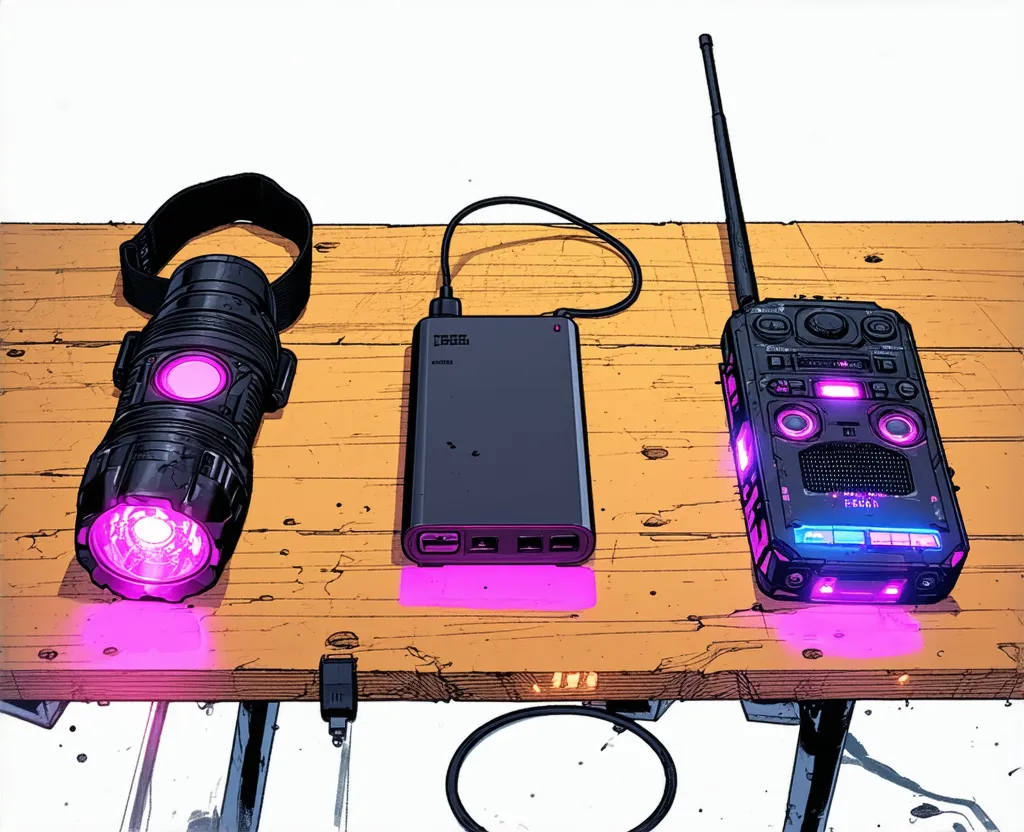
On the bench there's a grey plastic box. Inside, three unglamorous things: a radio, a brick of a battery, a headlamp. No blinking LEDs, no app. And yet if the power goes out for a whole day, those are the first three I'd reach for. At that point the phone is something you have to look after.
Why start here
In the last guide on the phone I wrote that many emergency features are already there and only need switching on. One condition remains: the phone has to be alive. When the power is out, the mobile network often clogs up or drops after a few hours, and the phone becomes a flashlight that drains. The physical kit covers three precise gaps: knowing what's going on, staying charged, seeing where you step. Three, not thirty. The rest is a different discussion.
The radio: the one that works when nothing else does
A battery radio picks up signal with no network, no subscription, and nobody knowing you're listening. That's why it comes first. What to check when you choose one:
- BANDS — FM and AM are enough. Digital (DAB) is handy but draws more power and isn't received everywhere
- POWER — ordinary AA cells, ideally with a hand-crank or solar top-up as a fallback. A tiny panel alone won't cut it on an overcast day
- RUNTIME — look at the listening hours claimed with real batteries, not at the speaker wattage
- HEADPHONES — a jack lets you listen quietly and makes the batteries last far longer
Find out beforehand which frequencies carry local information in your area: your municipality's civil protection office and local stations usually say so on their sites. The wrong moment to find out is when you need it.
The power bank: do the math before you buy
The box shows a big number, say 10,000 mAh. That number is misleading. The capacity is measured at the cell's internal voltage, around 3.7 volts, while the USB port delivers 5 volts: a good chunk is lost in the conversion, and in practice you usually get 60 to 70 percent. So a 10,000 mAh unit charges an average phone one or two times, not five.
The quick sum. Wh = mAh × 3.7 ÷ 1000. A 10,000 mAh pack is about 37 Wh. A phone battery is typically 12-20 Wh. Divide, then take off a third for losses.
Other things I look for: built-in cable or at least the right port for your cables, a readable charge indicator (four dots will do), and a capacity between 10,000 and 20,000 mAh. Bigger gets heavy and, on a plane, can easily pass the 100 Wh cabin limit that applies without airline approval.
Lithium cells lose charge even when idle. Top it up every two or three months and put a day in your calendar: the most useless kit is the one you prepared well and left flat in a drawer.
The torch: make it a headlamp
In the dark you need your hands. So I take a headlamp, with a handheld torch as the second. Few things matter: a red or low-intensity mode (it doesn't dazzle whoever is next to you and doesn't wreck your night vision), an economy mode with long runtime, and the ability to use common batteries. Sky-high lumens are marketing: indoors, 100-200 is plenty.
One rule for the whole kit: batteries out of the device, or with the insulating tab in. A leaking alkaline cell can ruin a radio for good, and it happens to exactly the things you don't touch for years.
> radio: AA cells + headphone jack
> power bank: 10,000-20,000 mAh, recharge every 2-3 months
> light: headlamp with red mode, batteries out
Where to keep it
Somewhere you can find in the dark without switching anything on: always the same drawer, near the exit or the fuse box. Tell whoever lives with you. Once every six months open it, switch everything on, check the batteries. Ten minutes. It's the only training this kit needs.
Frequently asked questions
What should a minimum emergency kit for a power cut contain?
A battery radio with FM or AM, a charged power bank for the phone, and a headlamp with spare batteries. These three cover information, communication and light without relying on the mains.
How many phone charges does a 10,000 mAh power bank give?
Usually one or two. The stated capacity is measured at 3.7 volts and roughly a third is lost converting to the USB port's 5 volts, so real output is lower than what the box says.
How often should the kit be checked?
The radio and torch every six months, the power bank every two to three months, because lithium batteries self-discharge even when unused.
Three dull objects in a grey box: survival, most of the time, is exactly this. May your code survive the apocalypse, and your batteries be charged when it counts.